
Browser-based neurofeedback app detecting real-time coherence states, seeking feedback
 neurokinetikz
United States
neurokinetikz
United States
Hi everyone,
I built a browser-based neurofeedback application that works on consumer EEG devices (Muse and BrainBit) and I'm looking for feedback from this community.
Quick background:
I've been analyzing EEG data from consumer headbands for several years. When I started digging into my own data, I found something I wasn't expecting. Earth's naturally occurring Schumann Resonance oscillates at ~7.8 Hz with harmonics at roughly 14, 20, 26, and 32 Hz. All of these overlap with canonical EEG bands. That overlap has been noted before but generally treated as coincidence.
My research suggests it isn't coincidence. I found that brain oscillation peaks can align with golden ratio (φ = 1.618) precision, anchored near the same ~7.8 Hz fundamental. I tested this across 1M+ peaks from multiple independent datasets. Less than 2% error. (And yes, I would be skeptical too 
Here's the paper:
Golden Ratio Architecture of Human Neural Oscillations (preprint)
https://doi.org/10.5281/zenodo.18244908
The research potentially validates ideas proposed about golden ratio organization of EEG bands in 2010 by Pletzer, Kerschbaum, and Klimesch at Universität Salzburg:
When frequencies never synchronize: The golden mean and the resting EEG
https://doi.org/10.1016/j.brainres.2010.03.074
Signal processing pipeline:
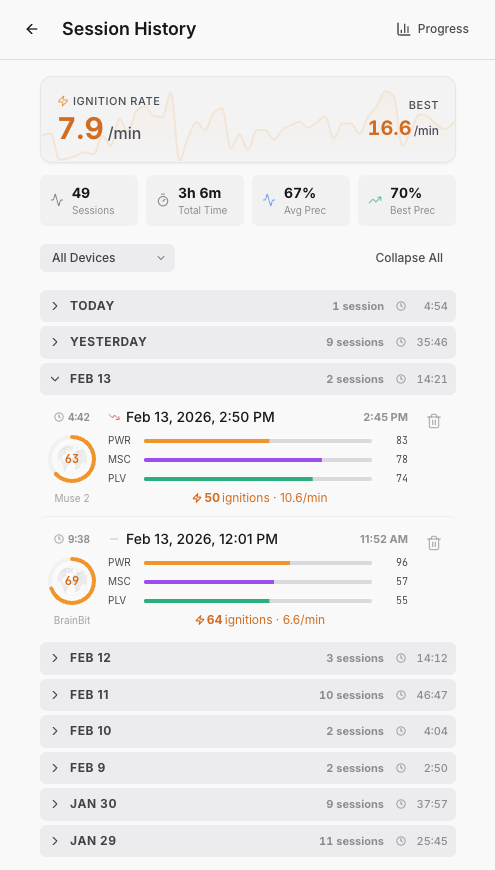
The app runs spectral parameterization (FOOOF) on each channel to separate genuine oscillatory peaks from the aperiodic 1/f background, then scores how precisely detected peaks match predicted golden ratio frequency positions across three bands. It simultaneously computes coherence, phase-locking value, and bicoherence across all channel pairs. When precision, amplitude, coherence, and PLV all pass threshold simultaneously for a minimum duration, it flags a Schumann Ignition Event and plays an audio tone through Web Audio API. Everything runs client-side in the browser. No backend signal processing.
Where OpenBCI comes in:
The biggest limitation right now is channel count. With 4 channels I can compute 6 channel pairs for coherence and PLV. With 8 I get 28 pairs. With 16 I get 120. The detection algorithm should scale well because more channel pairs means better separation of genuine cross-regional coherence from noise, and better spatial resolution for mapping where ignition events originate.
I'd also like to add OpenBCI support. For Cyton/Ganglion over Web Serial or Web Bluetooth, has anyone here built browser-based streaming from these boards? Curious about latency, packet parsing, and whether the throughput is sufficient for real-time spectral analysis at 250 Hz across 8-16 channels.
How to try it:
Open Chrome/Edge/Opera on desktop, go to https://resonate.neurokinetikz.com, pair a supported device or use demo mode without hardware. No signup needed.
Research code is open: https://github.com/neurokinetikz/schumann
Would love feedback on the detection approach, the signal processing, or ideas for OpenBCI integration.


Comments
Hi Michael,
Have you looked at the Brainflow / Typescript example codes?
https://brainflow.readthedocs.io/en/stable/Examples.html#typescript-get-data-from-a-board
I notice all those are using the simulated 'synthetic' board type. But it is possible the other board types are supported. I suggest you join the Brainflow Slack, and ask about browser support for serial port (Cyton) or Bluetooth (Ganglion) devices. See the Slack link in the Community section:
https://brainflow.org/
Report back to this thread what you find out.
Regards, William
Oh wow! I hadn't heard of brainflow yet. Thank you so much for sharing!!!
I took a very brief look at your paper. I see the correlations you are trying to make. Can you summarize what practical applications might result from your research? For example in neurofeedback, BCI, EEG medical diagnosis, implications regarding models of consciousness, etc.?
Regards, William
Sorry for my confusion regarding your app language. When you said 'browser-app' I assumed you were using javascript or typescript. I now see your app is entirely Python based, so obviously those are the examples you want to view.
Neurofeedback: Instead of training arbitrary band power, you can detect moments when multiple frequency bands simultaneously align to precise golden ratio relationships, igniting into transient multi-band coherence states.
BCI: If frequency bands follow φⁿ spacing, you can precompute exact cross-frequency coupling relationships rather than searching a high-dimensional feature space, potentially improving classifier performance for motor imagery and other paradigms.
Clinical EEG: The framework provides a normative model for spectral organization. Deviations from φⁿ alignment could become biomarkers for concussion, neurodegeneration, or other conditions. Herweg et al. 2025 (eLife) showed ~8 Hz precision is causally necessary for memory encoding, which converges with the framework's f₀ ≈ 7.6 Hz anchor.
Consciousness: The golden ratio's unique property, maximal resistance to mode-locking, offers a mechanism for how frequency bands communicate without synchronizing, directly addressing the integration/segregation balance central to theories like IIT.
Near-term application is neurofeedback. Longer-term clinical and BCI implications depend on ongoing replication.
Have you experienced 'shifts in consciousness' or perception, following such neurofeedback? What have been the results so far? So you are up-training coherence? Sometimes brain maps show 'too much' coherence, and training should be in the opposite direction.
Your paper mentions 91 subjects, is there any recording of their before / after experience with the neurofeedback?
Regards, WIlliam
My research examined publicly available independent datasets for validating ignitions and the proposed frequency architecture. No neurofeedback studies have been done yet. And I have only recently created the app and have been using it for just a few weeks, still collecting longitudinal data. That said, subjectively, it "feels" right. Moments of ignition generally occur more frequently and powerfully the deeper into a meditation I get. And the more I let myself "blend" with the audio feedback (if that makes sense), the more it feels like I can influence toward ignition. After sessions of only 5-10 minutes with the feedback, i feel similar to a 20-30 minute normal session. Deep calm presence, expansiveness, easy breathing. No perception shifts.