
4 channels limit per board / periodic spikes
 Januz
Philippines
Januz
Philippines
Greetings everyone, I noticed that my stream produces constant spikes at periodic rates, as seen in the image below.
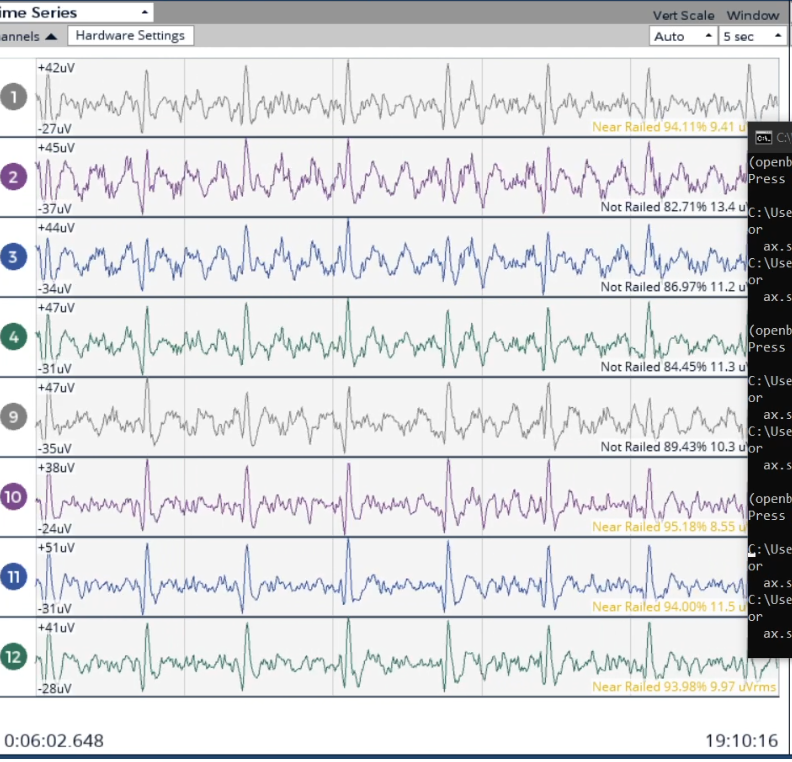
For context, I'm using 8 gold cup electrodes that I bought here, while the Cyton + Daisy was bought elsewhere. These two can only provide one half of its channels, giving me a total of 8 channels. Is it appropriate for the stream to produce such periodic spikes? Or is there something that I might have missed, perhaps in setting up my equipment? I'm wondering if the spikes could be a reason why my Neuropype Pipeline does not classify correctly. Anyways, thanks for taking the time to read.
Comments
Please clarify. Did you purchase the Cyton + Daisy from the OpenBCI Shop? What do you mean by 'elsewhere'? From another user selling a used system? There are quite a few Chinese clone makers selling defective equipment.
One of the defects seen is that the ADS1299 chips being used, only have 4 channels usable instead of 8. This has been seen before, and a blatant example of the ripoff nature of these clone systems.
Another aspect of the clones, is that they 'try' to emulate the functionality of the no-longer-sold Wifi Shield. It has been known for a long time that the Shield does not work well with Cyton. Exhibiting spikes and anomalies. It is planned to eventually fix the engineering issues of the Shield with Cyton combination. But timeline is unknown at this point. Any clones using Shield-like components will be subject to these anomalies.
William
Hi, thanks for replying. I indeed bought it from a local electronics shop, and they said something about it being 'homebrew' and that's what we can afford for now.
If that's the case, I'd like to ask how such anomalies can deeply affect the calibration process found on the Motor Imagery tutorial or even the entire data/stream? And is there such a way to alleviate this (asides from buying the genuine parts in which we are also considering)?
If you are always seeing the spikes you show in your image, that is going to wreck any data analysis or signal processing you are attempting.
My impression is that you have one of the clones that is combining the Cyton with the Wifi Shield. There are many different settings changes you can try to adjust with the Shield parameters, such as TCP vs UDP, wifi direct vs wifi via router, etc. Try the UDP mode first, then experiment with the wifi direct, it should work better than via the router.
https://docs.openbci.com/GettingStarted/Boards/WiFiGS/
https://docs.openbci.com/ThirdParty/WiFiShield/WiFiLanding/
More description of the actual Shield hardware issue:
https://openbci.com/forum/index.php?p=/discussion/2108/measured-shield-regulated-3-3v-supply-has-6v-dip-at-1-second-intervals-with-resonant-ringing
Greetings, thanks for replying. I'd like to quickly ask if these things that you've recommended is applicable even if I'm using an USB dongle in connecting the board instead of connecting via Wi-Fi? Since the shield component I only have is the Daisy, and not the Wi-Fi one. Also, thank you for the suggestions.
I don't know what the Chinese clone makers are selling. If your dongle is this:
https://shop.openbci.com/products/dongle
Then you are NOT using Wifi Shield, but the original Bluetooth-Gazelle radio protocols. So that makes the spikes you are seeing even more unexplainable. Many of the clone makers are shipping nested boards that include the former Shield.
Indeed, I am not using the Wifi shield however I am using the additional 'homebrew' Daisy board which might be subjected to such anomalies. I will try to use the Cyton board alone and see what happens. Thank you for responding.
Others suggested that my data could be picking up residual (and unwanted) cardiac signals, since the counted spikes converts to approximately 96 beats/min. They suggested for the stream to be cleaned, however it could also affect the neural signals mixed in. The problem could also be attributed to the way that I setup, hence they advised me to "fix your recording setup to avoid picking up the cardiac waves in the first place (e.g. garbage in, garbage out)" in which I also believe that it could stem from my setup since there are instances in which different channels pickup data at varying amplitudes and frequencies while there's also an instance wherein, they share the same frequency, which I assume looks noisy.
For added context to the outputs. here's the stream when using the Cyton board alone:
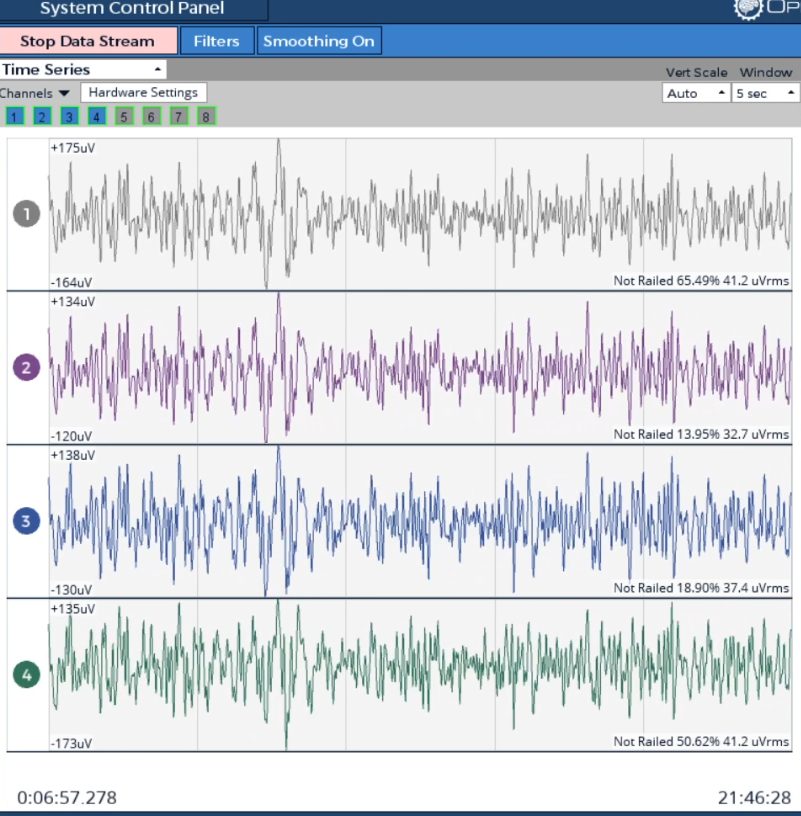
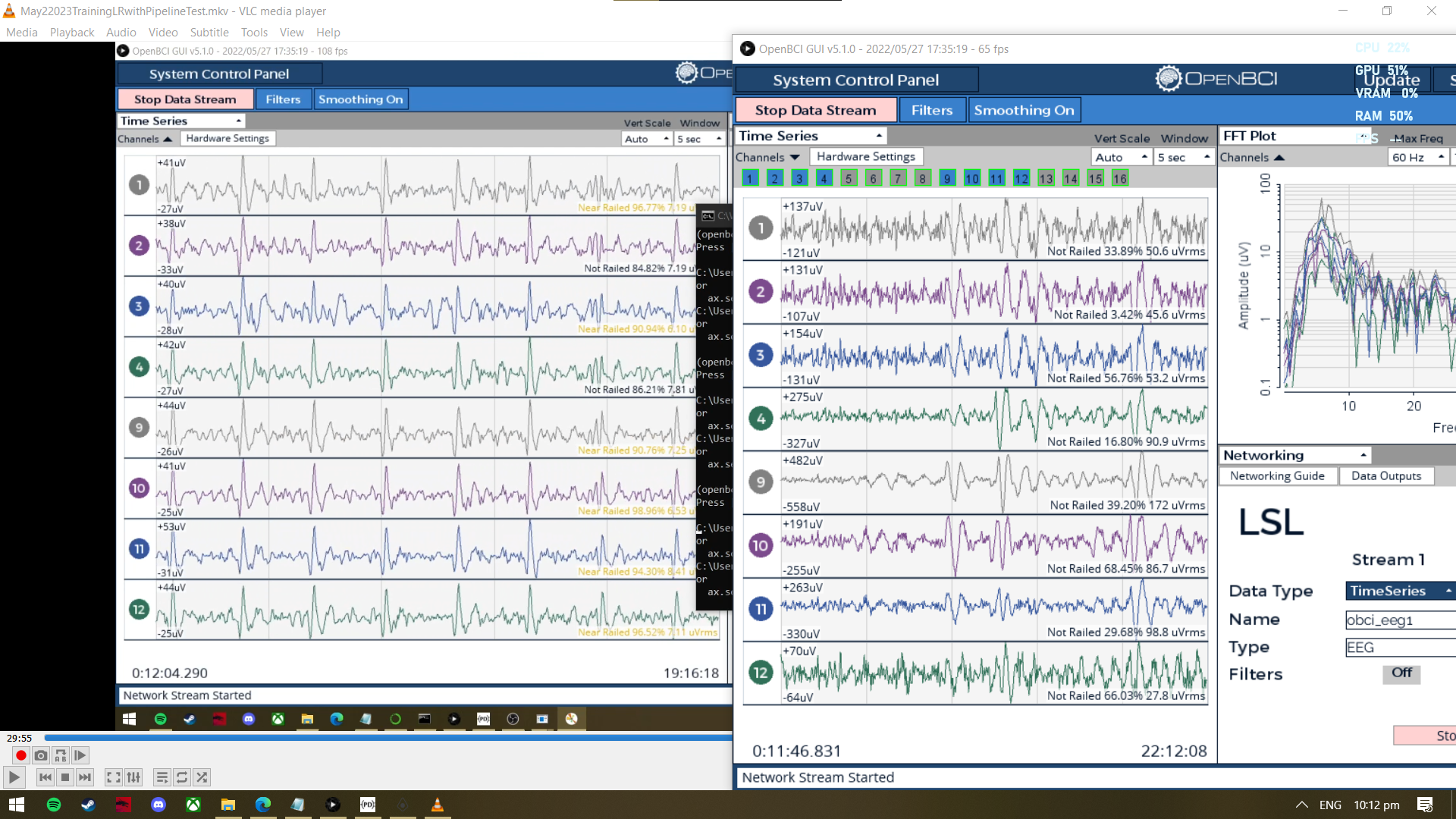
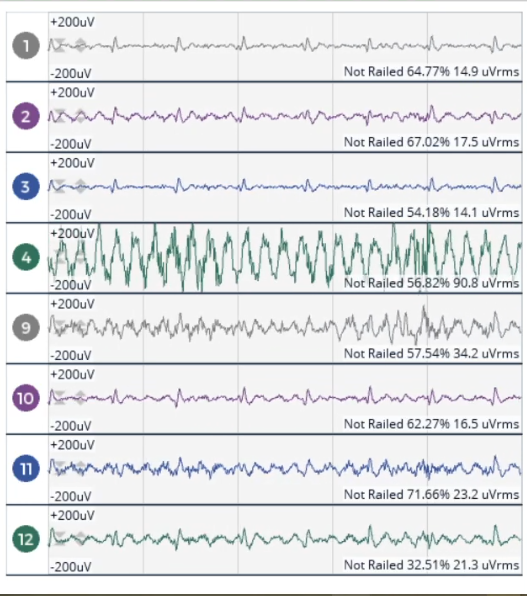
And here are the other streams with the 8 channels on different days and sessions:
I hope this helps, and thanks for taking the time to read this.
This is a good suggestions, however it seems unlikely that the same exact heart beat signal would be picked up simultaneously on ALL EIGHT channels. All of your images show this.
Yes, it is always a good idea to remove artifacts before they are recorded.
There is a simple test you can do with one or more channels. Just connect the channel(s) together with a blob of paste or alligator clips, and also include in that bundle the SRB2 reference and Bias (Ground) electrodes. This should result in very close to ZERO microvolts.
Greetings,
I have done this:
And the results are exactly as what you said:
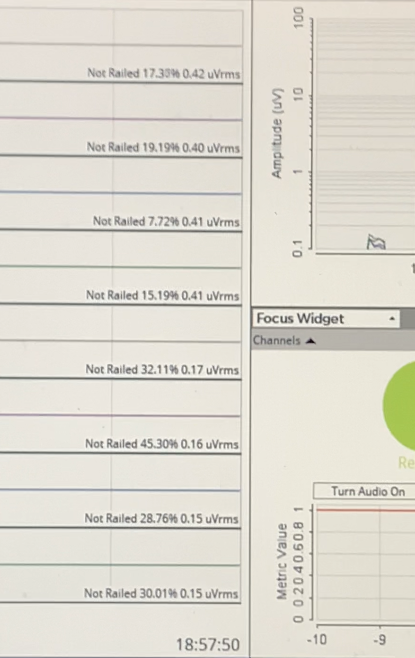
Also, I managed to pass the signal from the LSL stream into some artifact removal pipeline in Neuropype, however the 'clean' data is identical to its input. This particular node (artifact removal) in Neuropype has its threshold parameter set to 2.5, which in their documentation states as "the most aggressive value that can be used without losing too much EEG."

The blob test provided good results however passing the data into a sample artifact removal pipeline didn't provide any difference. Any ideas are much appreciated, and again thanks for reading this.
Since this Cyton + Daisy you purchased is a 'clone' and not manufactured by OpenBCI, have you tried contacting the original manufacturer in China. I suggest you mention:
Regards,
All the 'blob' test does, is verify that the ADS129x differential amplifiers properly show zero microvolts when inputs are shorted together. Nothing more.
Looking at the two windows inside your Neuropype screen shot, shows that both of these show major mains frequency (50 or 60 Hz) interference. It is remotely possible that the roughly .8 Hz spikes shown in all your time series, are ALSO related to some EMF electromagnetic frequency noise source in your immediate area. In such cases it is always good practice to get as far away from EMF sources as possible. This may require moving to another room or area. Be aware of: extension cords, power supplies, LED lighting, wireless gear, cellular base stations, conduits in walls floors ceilings, etc.
Thank you very much for the inputs.