
Fabric sensors vs Gold cups with Cyton. Can't find alpha.
 NinjaPotato
Bologna, Italy
NinjaPotato
Bologna, Italy
I'm trying to make a comfortable eeg headband for long uses for a university research project.
The conductive fabric electrodes seem really fit for this use case, so I tried experimenting with them.
I cut and soldered 3 sensors from this aliexpress conductive fabric that I bought. I soldered it directly to the pin cables that go to the Cyton.
For the fabric sensor setup I used the center sensor (that you can see in the picture) as reference and the other two as normal channels.
The electrode cap has 3 main sensor plus a reference and a bias.
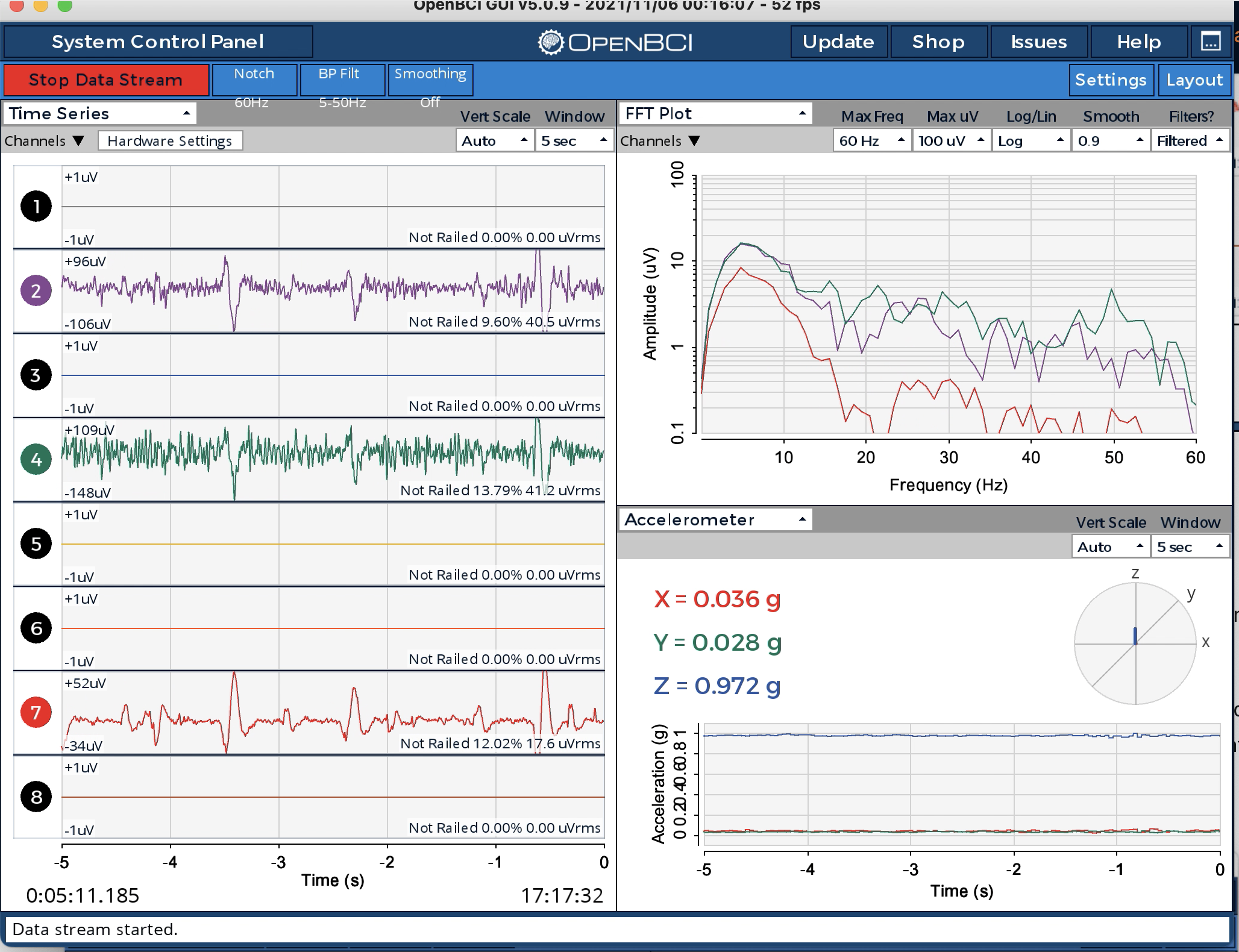
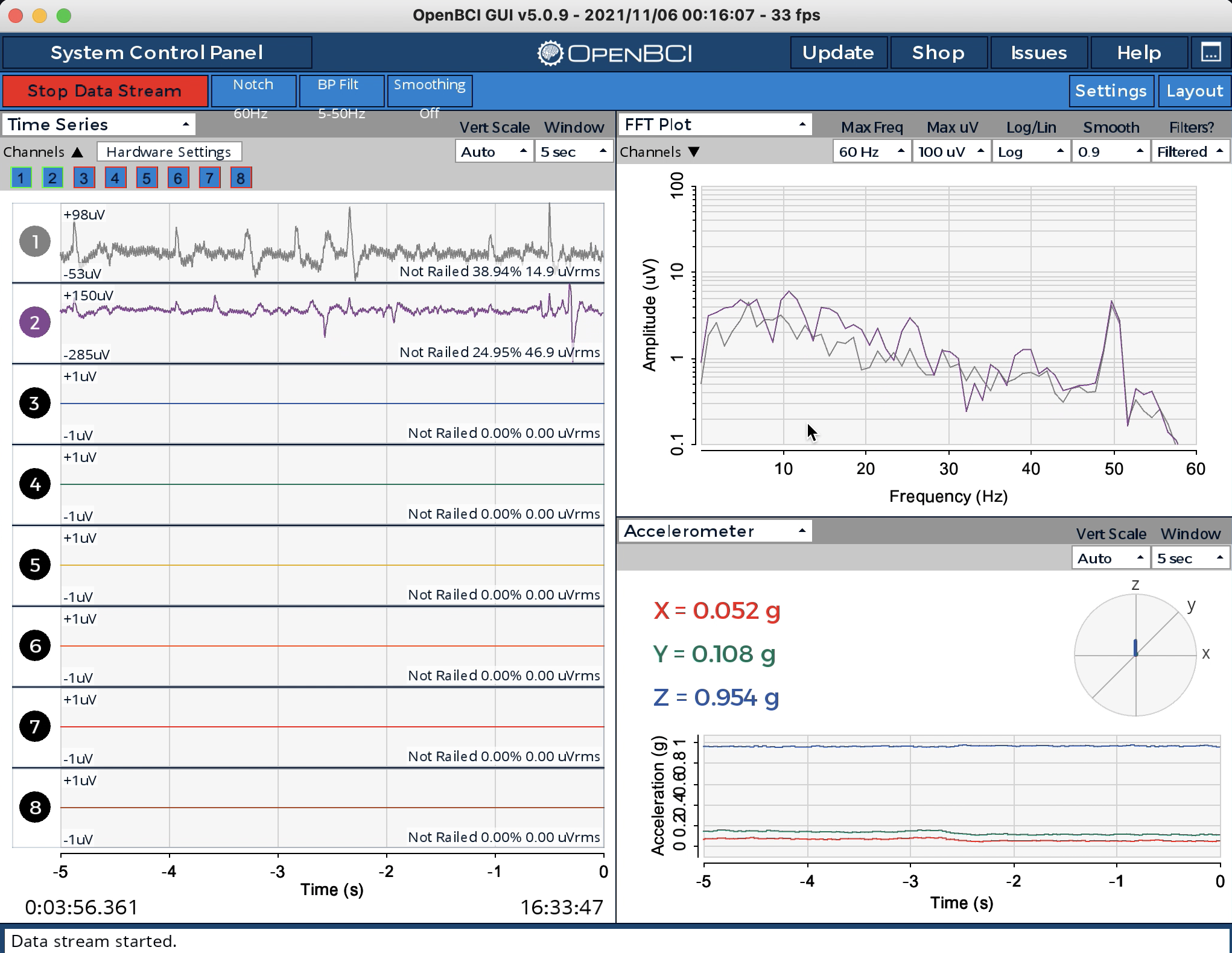
Now my doubts are: why is the fabric sensor version so "energetic"? As you can see the uVrms is much higher compared to the electrode cap version. My hypothesis is that, given the relatively "huge" area of direct contact of the sensor to the forehead skin, it is extremely sensitive and therefore very noisy too. My other big concern is that I can clearly see the eye blink reaction (video), but I don't really know if it is just because of the "jolt" of the surrounding skin, or if it's actually picking up the EMG from the muscles.
And of course, the elephant in the room, I didn't manage to pick up the alpha state 10 Hz peak in any case, neither with fabric one nor with the gold caps. I've tried it on 4 friends of mine, but nothing.
One strange thing is that in the fabric version the 50 Hz is always peaking. Any guesses why? Plus, the fabric one time series plot sometimes look "normal", but most of time looks over-excited... don't
Any suggestions on how to improve and reduce the noise and "volatility" of my setup? Maybe just one reference isn't enough and I need the bias too? Maybe the sensors are too near one each other and there's "crosstalk" if it even is a thing. Or maybe it could also be that the yellow fabric on which I laid the fabric sensors somehow is a bit conductive and "shorts" the sensors. I should try putting them on plastic.
I've uploaded the side to side comparison videos of both the headsets on youtube at this link.
Gold caps
Fabric
Thank you so much for the help, I'm a complete noob to EEG
Comments
Hi Ninja,
Your 'notch' frequency setting must match your local mains frequency. Here in the US that is 60 Hz, but in Europe it is 50 Hz. If you use the wrong setting, you will see a lot of mains artifact, and it will also contaminate other frequency bands.
Best locations for finding eyes closed alpha, are in the rear of the head: O1 O2 Pz P3 P4. Also there is considerable variation in alpha production between individuals. So try a few subjects.
Conductive fabric will work on bare skin areas. But actually may produce less alpha than EEG-specific dry electrodes, which are made of molded plastic, plated with silver, then chlorided. The silver+chloride really increases sensitivity and noise reduction. Silver by itself with no electrolyte would likely be quite noisy. You might try spraying with a bit of water or saline, that will increase conductivity.
https://shop.openbci.com/products/openbci-eeg-headband-kit
https://fri-fl-shop.com/
Regards, William
Ok, I'll try with the O1 O2 Pz P3 P4, that's probably it since mine were located only in the front.
In my case I just have one single "teeth" like sensor which could be suitable for that position to penetrate hair touching the skin.
I was wondering if putting 2 textile sensors on the T3 T4, like the Muse S headband does, just above the ears where skin is exposed. 3 in the front (Fp1, Fp2, FpZ as reference). Then put just one (the oly one I have) in the Oz position. Would it be good enough to catch eyes closed alpha?
I've attached an image on how my current "setup" is and where I would apply the other sensors (the one in the back on the white elastic is the toothed one).
