
What does reference impedance mean and what should I expect?
 nirajgupta
California
nirajgupta
California
in Cyton
I am using the Ganglion board and headband kit with dry flat electrodes
Three pins are connected: left ear clip to REF, right ear clip to D_G, FP1 connected to "+1"
What does the reference impedance represent? Please provide a high level description since I have a limited background in programming and electronics.
Follow-up questions: Is there a range of acceptable reference impedance values? What does it mean if the reference impedance is "very" different from the impedance of the FP1 channel?
Thank you
-Niraj
Comments
Niraj, hi.
The thread below has some details on the Ganglion impedance hardware / firmware.
https://openbci.com/forum/index.php?p=/discussion/3211/ganglion-impedance-measurement-details-resolved
All impedance measurements require passing a calibrated micro current, through a pair of electrodes. Cyton does not have the ability to measure the reference impedance, but Ganglion does. Likely because Ganglion is using the D_G pin as the other electrode of the pair. Cyton impedance checks are between reference (SRB2) and the measured channel. Hence reference itself cannot be measured.
re: "..Is there a range of acceptable reference impedance values? What does it mean if the reference impedance is "very" different from the impedance of the FP1 channel?..."
You can try swapping the earclips attached to the pins in question (D_G and REF), and see if the high impedance shifts. In that case you might suspect the high impedance ear clip to have some wear or degradation affecting impedance. But since the same pair is involved regardless of the pins, you might just measure exactly what you did before. See if the Fp1 value changes.
Why don't you report here, the values you are seeing?
Generally with dry passive electrodes, the impedance is hugely dependent on the pressure of the electrode on the skin. And such impedance is usually quite a bit higher than with 'wet' electrodes: gel, paste, even water. So you could also try some experiments slightly moistening the skin beneath the contacts. To see how that shifts the impedance.
William
Hi William,
Thank you for your response.
Yes, I'd be happy to share some values I got: FP1 channel impedance = 57.5 kOhm and reference impedance = 28.5 kOhm. I had some floating pins on the other channels giving impedance readings around 600 kOhm. I noticed that when I took the headband off, the FP1 channel impedance also rose to about 600 kOhm. However, the reference impedance remained around 30 kOhm. Would you be able to provide some insight on whether you would normally expect this?
Thanks for the ideas on things to try.
-Niraj
My curiosity on this matter initially started when I realized I wasn't getting any EEG signal, only noise. I'm attempting to share a screenshot of my simple setup as described previously.
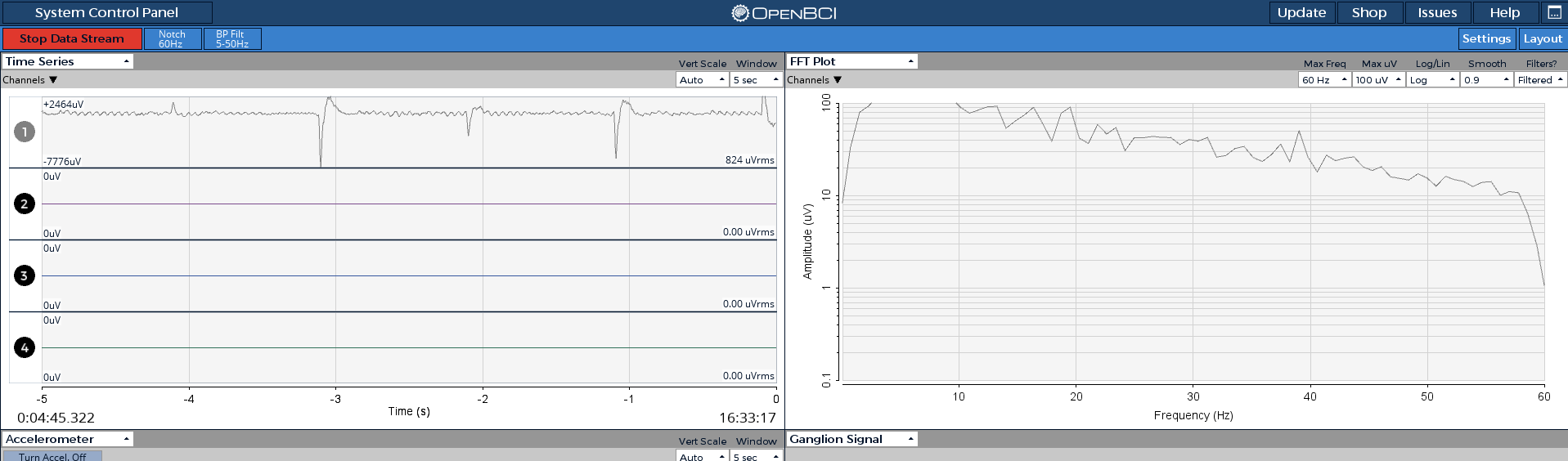
These are decent readings and acceptable. As I mentioned, passive dry electrodes are by nature higher impedance. Did you see my other comments, and try any of these suggestions? With dry electrodes like this, impedance is directly related to / dependent on pressure against the skin.
Channels not in contact with the skin, will show large values, that are not completely accurate. Technically a disconnected electrode should show an 'infinite' impedance. But the algorithms and firmware use some constants that probably account for the 'infinite' == '600K'.
The previous comment I left mentioned how the D_G and measured electrode (for example REF or Fp1) form a pair, into which a standardized AC current is injected. Since your REF and D_G ear chips are still attached, that is why the REF still shows ~30K.
Yes I've read your comments. I tried swapping the ear clip connections between REF and D_G. I got the same impedance results. After reading through the Ganglion Specs document, it is my understanding that the top and bottom pins corresponding to REF and D_G are the same. So, I tried switching between top and bottom pins for REF and D_G respectively as well. This didn't change my results either.
I don't suspect degradation or wear is an issue for me since I just received my OpenBCI products about a week ago.
I didn't try moistening my skin-electrode contact since the impedances of interest (FP1 channel and reference channel) didn't seem like they needed to be lower.