
Changing ECG polarity (noob question)

Hi, Just received Ganglion kit. Using the skintact electrodes to do the ECG tutorial I notice a couple of things:
1. The best I can get is about 27K ohms impedance instead of the 7-10K the tutorial talks about
2. The heartbeat signal seems to randomly invert for a few beats and fades in and out in strength. I will get several good beats and then start getting inverted beats, etc.
3. The signal level of good beats is about 1500 uVrms, but can vary from 400 to 2600 and intermittently flashes 'Railed'. I don't see a lot of noise, nice clean beats but vary in strength quite a bit.
What is causing the inverted signal? I was hoping that the ECG would be a pretty steady and reliable signal.
-mark.
Comments
Mark, hi.
When you go through all of the steps of the Ganglion tutorial, do you see the other signals as expected? (EMG, EEG.) Does impedance look ok on those signals? As long as the 'dot' shown in the impedance windows is NOT red, you should be ok. 27K is not that far out of line, and impedance can vary depending on skin oils, soaps and shampoos used, etc. Sometimes skin prep is done with various means (alcohol pad, abrasive creams, etc.) if lowest possible impedance is desired.
re: #2, inversions are sometimes seen in various T, P, etc. portions of the ECG waveform. See:
https://www.google.com/search?q=ecg+inverted+t+wave
Have you tried measuring ECG on a friend to see if the wave is any different there?
re: #3, signal strength can also be affected by the position and quality of the electrode contact. Typical ECG is done with electrodes on the chest, with the position just inside the left/right shoulder joint area.
@BillH might have some insights on inversions.
Regards, William
The inversion, when it varies on and off, is usually related to technical difficulties with electrode placement. In particular, if one electrode is not always making good contact, the combined (difference usually) signal of the two electrodes will vary accordingly.
Sometimes the heart itself is conducting its beat in two different ways. That would require a full ECG with specialty medical equipment to decide. In a person without known heart problems, I would try better electrode contact first.
Thanks William & Bill,
I stayed playing with the ECG as described in the tutorial, trying to get that perfected. I do need a good ECG heartbeat stream for another project I'm doing, so I do want to get that working.
I was using placement on the arms as shown in the video. Tomorrow I'll try with fresh skintacts and alcohol prep, and maybe chest placement, and then I'll move on to the EMG and EEG. I did try all four channels and got pretty much the same result.
The kit came with two sets of snap cables, three individual ones (I used) and a ribbon cable-based version, so I can try the other set to see if that helps at all.
Interesting about the inversions... pretty sure it's not me, but it could be my electrode(s) ;-)
I think doctors would've commented on past ECGs if they saw things flip-flopping like this!
Thanks again for the hints William & Bill. Tonight I was able to get through all the tutorial.
The ECG I did with fresh skintacts and placement on the chest and lower abdomen. I was able to change the polarity of the signal by just choosing which electrode was positive and which negative and swapping the lower abdomen and upper right chest electrodes around to be either D-G or the +/-.

Signal levels were lower than I expected at about 50uV
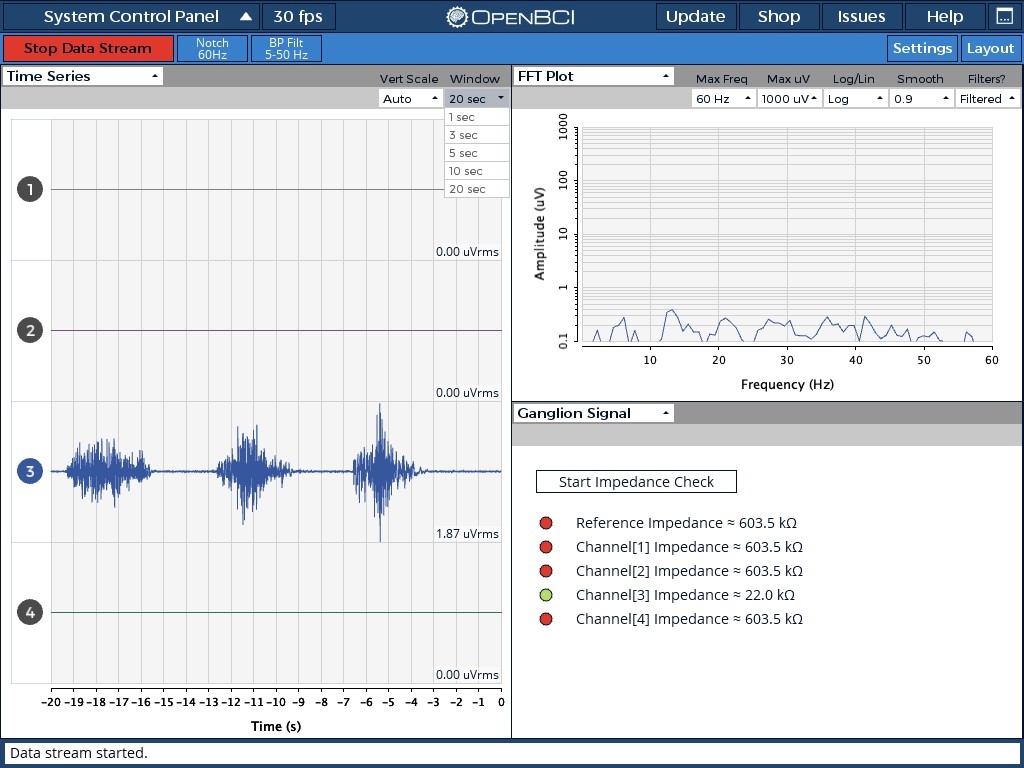
Also got EMG:
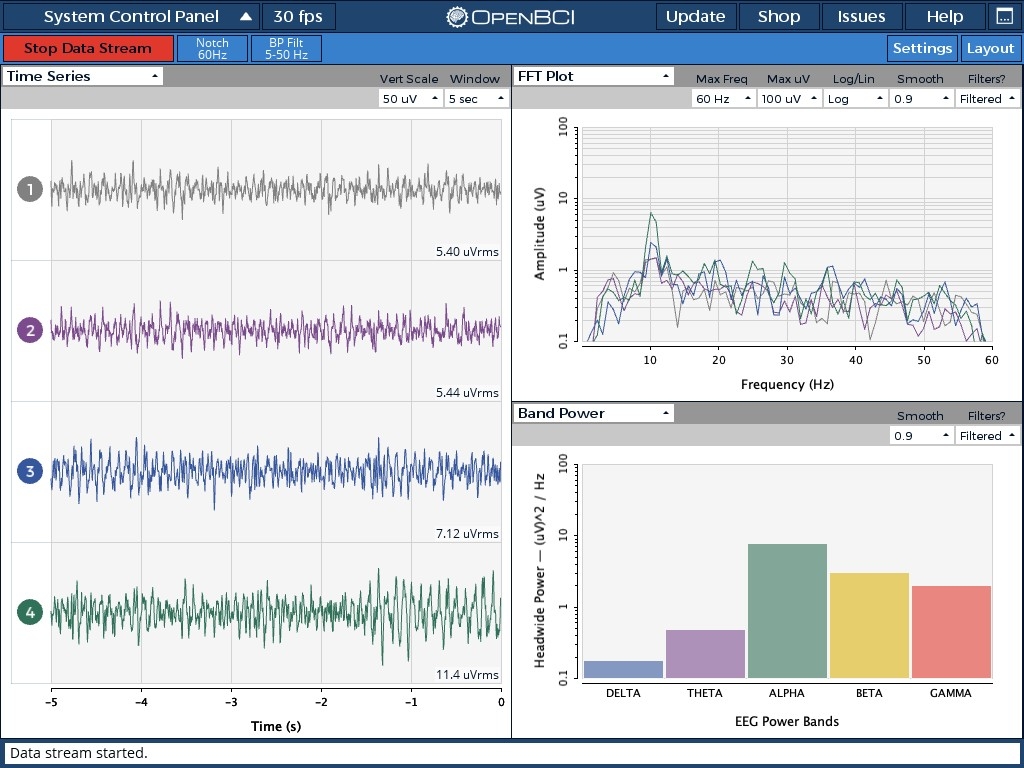
And was able to produce somewhat of an alpha peak:
The headband had to be an awful lot tighter than I was expecting in order to get the noise down on the EEG!