
Strange Data from Headset - All 16 Channels, Same Pattern [resolved]
 Anastasiya
USA
Anastasiya
USA
Below is a screenshot of what the EEG data looks like in the GUI:

I initially thought perhaps the battery was low, but it was fully charged. Turning the headset off and reconnecting seemed to fix the problem briefly, but the activity returned to this unusual state shortly afterward. Could this have anything to do with me using LSL to stream the data out? Are there known causes for this behavior (or has it at least been seen before)?
Comments
This better shows the waveform:
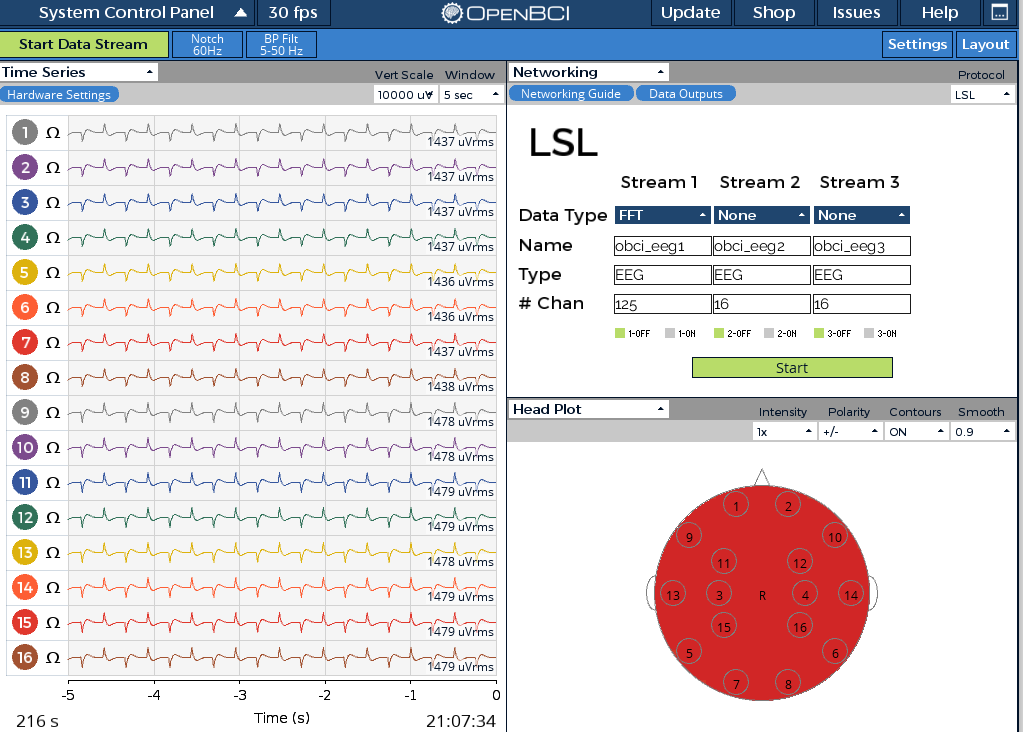
Also please note that it seems after recording activity normally, at some point all the channels flatline, and after a second or two they show this unexpected waveform.
https://openbci.com/forum/index.php?p=/discussion/2367/strange-synchronous-ecg-and-eeg-artifact
The above post seems to have a similar problem - running the headplot may be causing/contributing to this issue. I tried replacing the head plot with the FFT plot and while it took longer than before for the unexpected activity to occur, it still occured.
There is no reason for any other widget to be modifying data in the TimeSeries. It is only affected by Notch and Bandpass filter. It's true from the previous thread that Headplot can be greedy. In the screenshot below, you can see this is not the issue.
I think this is actually being caused by hardware, the battery, or how the leads are connected, since the pattern seen in the screenshots is the same from second to second.
The leads need to be connected to a human with earclip electrodes. This crucial detail is not mentioned. I would try again with the Cyton and earclips connected.
Thank you for the response.
I had the headset on my head with all electrodes making contact with my scalp and with earclip electrodes clipped onto my earlobes. I was getting normal data at the beginning of the recording. Without me moving the headset or unclipping anything (my head was still and I was looking at an image on a computer screen) the timeseries data for all channels flatlined and then came back with this pattern.
I will try a different battery tonight, but it's hard to tell what changes actually fix this problem as it's not present in all recordings and seems to come up randomly
This is all very awesome and helpful info! Given that everything was connected and you saw good signals, this is definitely something weird with hardware. I believe that the software is working properly, which is why we see these strange artefacts and they appear regularly (e.g. they look the same from second to second). You can also try turning off the filters, but I think you will still see strange artefacts.
I've seen this type of behavior and weird signals when my batteries are low. Even though battery may have reported it was fully charged, I think it's the right idea to try another. Let us know how swapping batteries works!
Cheers,
RW
Ana, hi.
Since these are rechargeable batteries, sometimes odd things can happen when rechargeable cells have different charge histories and age. One wonky cell can throw off the set of 4. If you are using a "rapid charger", this can also affect cell longevity and health.
If you want a comparison benchmark, suggest getting a new set of 4 AA alkaline batteries, manufactured by a quality company. Compare that result to what you are seeing with the rechargeables.
Same is true if you are using lithium cell. Rapid charging is known to reduce cell lifetime and stability.
Regards, William
Hi!
I just wanted to chime in that I have noted the exact same weird pattern. (Cyton + Daisy over BLE). It happens randomly after variable recording time. I was not streaming through LSL. I agree this is definitely a hardware problem, it looks like the board behaves as if it had received a control signal (test square wave, all flat electrodes, event shutting down in our case). Can any of you confirm that this is a glitch related to battery charge levels? I will soon be switching to higher capacity Li ion so I could report on that eventually
It is almost certainly battery related. Especially if you are using rechargeable AA cells. If the individual cells have been separately charged over a period of time, (thus having different age and chemistry) -- it's more likely odd discharge stability will occur.
If you see such a weird pattern again, check your pack output level, it should be 6V and above when fresh, with alkalines. You can also check the Vdd and Gnd pins on the board. This is after the voltage regulator. If you do not see above 3.3V, then the hardware will do very glitchy things.
I just wanted to add that I have never used AA batteries or the included battery pack before with this headset - I've instead been using a rechargeable 3.7V 500mAh battery from Adafruit (https://www.amazon.com/ADAFRUIT-INDUSTRIES-1578-Lithium-Polymer/dp/B00L0W61VO).
I haven't done many EEG recordings this past week so I don't yet know if the problem is still there. However, since this problem was recurring, is there a different battery that's recommended to avoid it? Should I get one with a higher voltage, since you mentioned the AAs that are expected to be there would be at 6V when fresh? The next step up from 3.7v for these LiPoly batteries seems to be 7.4v (i guess they just stick two of the 3.7v ones together and call it a day?), but that goes above the 6V max warning on the cyton board page (https://shop.openbci.com/products/cyton-biosensing-board-8-channel?variant=38958638542).
Side note (assuming the 3.7V LiPoly batteries are fine and mine is just problematic all of a sudden): I see several similar looking 3.7V 1500mAh batteries (like this one: https://www.amazon.com/1500mAh-battery-Rechargeable-Lithium-Connector/dp/B07BTN9TYN/ref=sr_1_3?keywords=3.7v+1500mah&qid=1583347214&s=electronics&sr=1-3) and was thinking of getting them so I could record for longer between recharges. Would this be okay/safe?
500 mAh battery is relatively small as far as Lipo cells go. Note that the Cyton mainboard alone is drawing about 50 ma. So if fully charged and not an old or damaged cell, the battery could power the mainboard for about 500 / 50 = ~ 10 hours. With the Daisy added, power consumption will increase, not sure of the exact figure, but less hours, possibly half. You may well have a damaged cell that is not obeying the normal discharge curve.
A larger rated mAh battery is fine, many varieties available:
https://learn.adafruit.com/li-ion-and-lipoly-batteries
"However, since this problem was recurring, is there a different battery that's recommended to avoid it?" As the cell drops below the required 3.3V, yes it will recur each time. There is nothing unusual about this. Larger capacity mAh will give you more hours, calculate it out.
Here is a possible way for you to quickly check level before a session. You press the button and it lights to show charge level:
https://www.banggood.com/Voltage-Capacity-Display-5-LED-Battery-Indicator-Board-to-1S-2S-3S-4S-3_6V-16_4V-Li-ion-LiPo-Battery-p-1387404.html?ID=47893&cur_warehouse=CN
The single lithium cells are called "1S", the two cell you mentioned is "2S", producing 7.4V. There is no point in going to a two cell. Because the main consideration is the mAh provided. Although Cyton could handle 7.4V, the voltage regulator is rated up to 12V input. Other issue with 2S is that you would need a new charger, and matching connector cables. Best to avoid possible confusion.
I saw your link to the battery on Amazon. In general I would trust batteries sold by Adafruit over other suppliers. They know their sources better. Arbitrary Chinese suppliers may be less quality, or even non matching connectors.
Regards, William