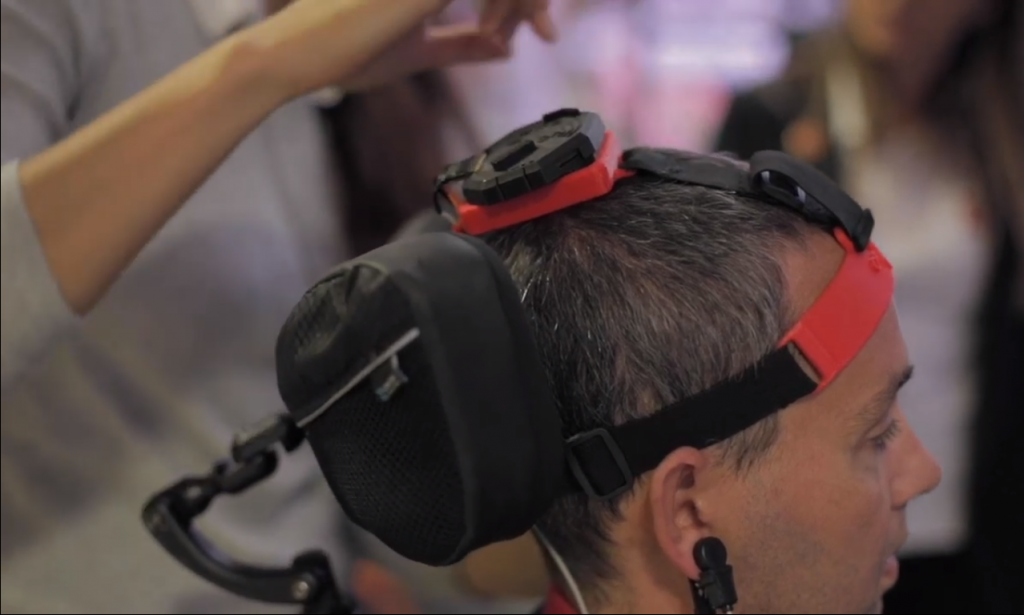
We would like to share our last headband prototype using OpenBCI Ganglion board. We are OTTAA Project, an Argentine startup that develops Alternative and Augmentative Communication (AAC) systems. Our first development is OTTAA app, a digital AAC that uses pictograms and artificial intelligence to restore communication to non-verbal people.
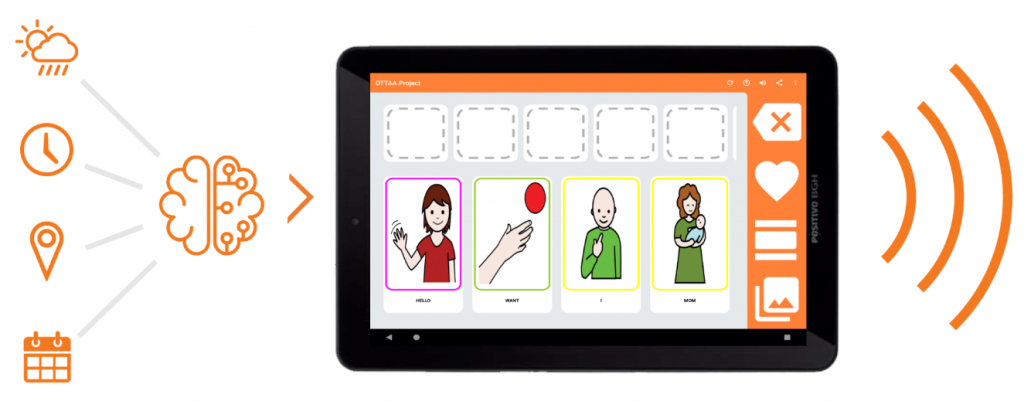
Now we are committed to the development of a Brain-Computer Interface to provide accessibility to people with severe motor impairment. We are using Ganglion board and dry electrodes from Florida Research Instruments Inc.
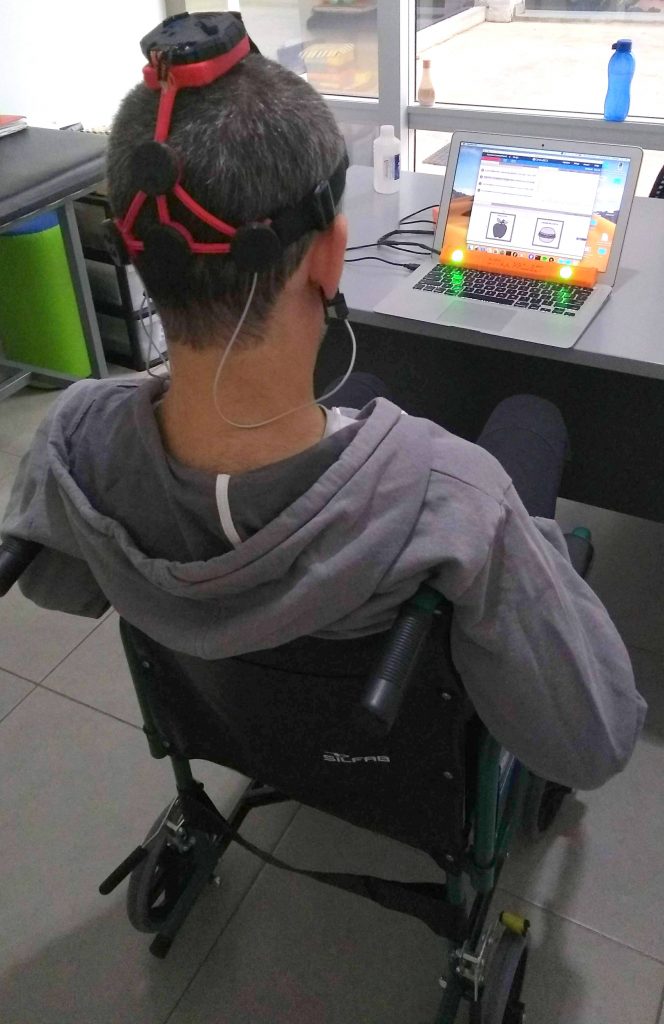
Our BCI system is based in Steady State Visual Evoked Potentials (SSVEP), thus we use a visual stimulator to elicit evoked potentials in the occipital area. Our headband has 4 channels referred to the ear lobe, placed in PO7, POz, PO8 and Pz according to the international 10-20 system.

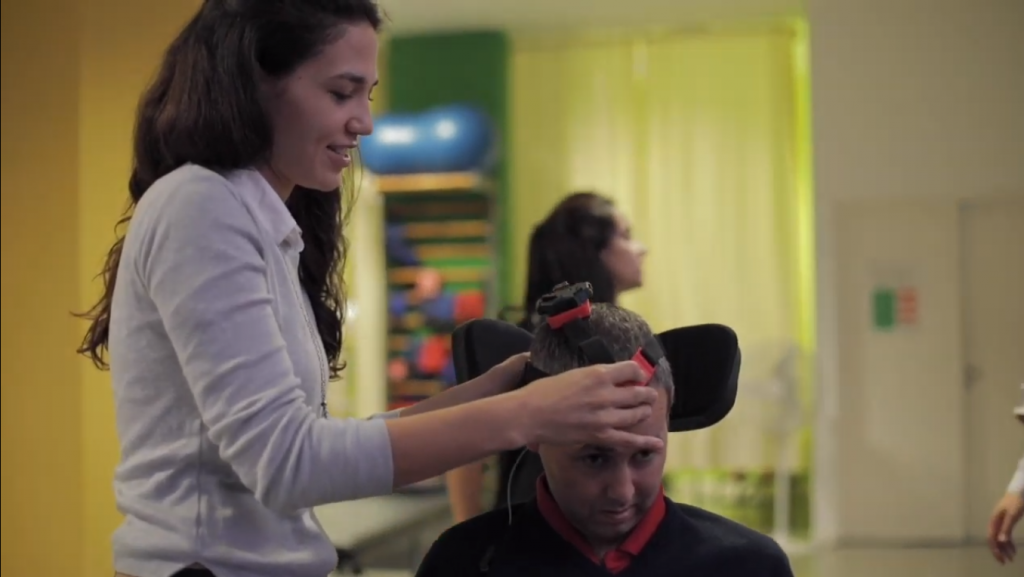
We designed the headband focusing on usability and signal stability. Since our AAC system is intended to be used in daily life, we need a portable and wireless device, that is comfortable to wear and provides good signal quality during usage. In addition, its placement must be quick and easy, with minimal training, so everyone can place it on a user with motor impairments.
We started using the Mark IV headset for channel selection and proof of concept, and then we performed several design iterations to improve headband adjustment and electrodes contact.
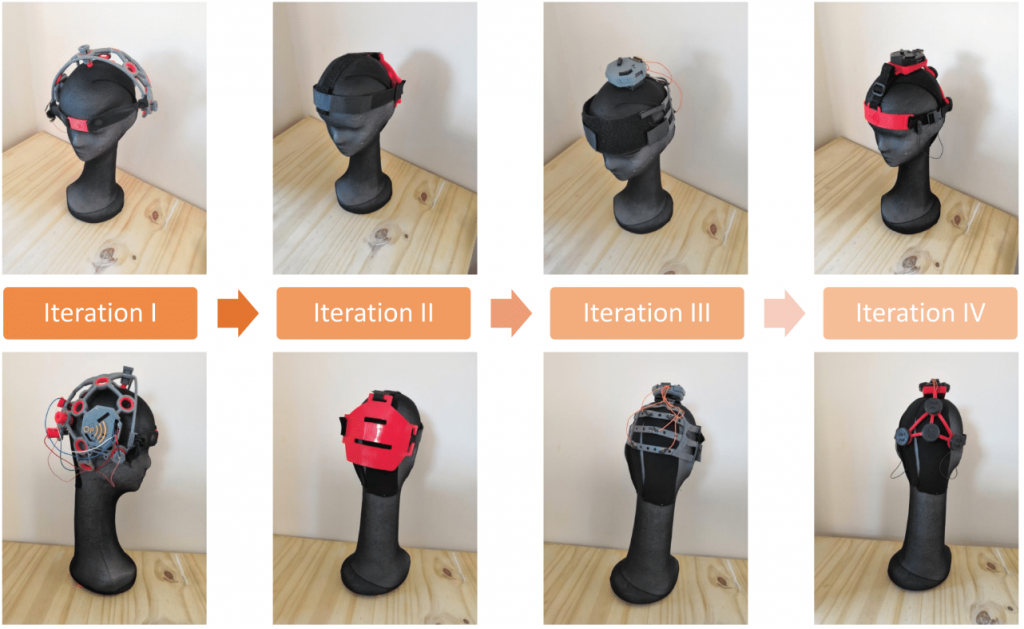
We improved the electrodes contact with the scalp by fixing the electrodes to a 3D-printed flexible structure, adjusting it with elastic bands. This provides good electrode contact without excessive pressure on the scalp, by adjusting the electrodes together when placing the headband. We have worn it for up to 1 hour, with good signal quality and no user discomfort. The setting can be a little tricky for users with long hair, but it works well once placed in the right position.
We also designed a case for the Ganglion board and the battery, adapted from the OpenBCI case design, so it is embedded in the headband and provides full portability.
We implemented the visual stimuli in a 3D printed case with LEDs, and the user interface in a customized widget of OpenBCI GUI.
We started testing it with healthy volunteers, and now we are testing it with subjects with motor impairments due to Amyotrophic Lateral Sclerosis (ALS) and Cerebral Palsy (CP). Watch here the video of one of our first test!
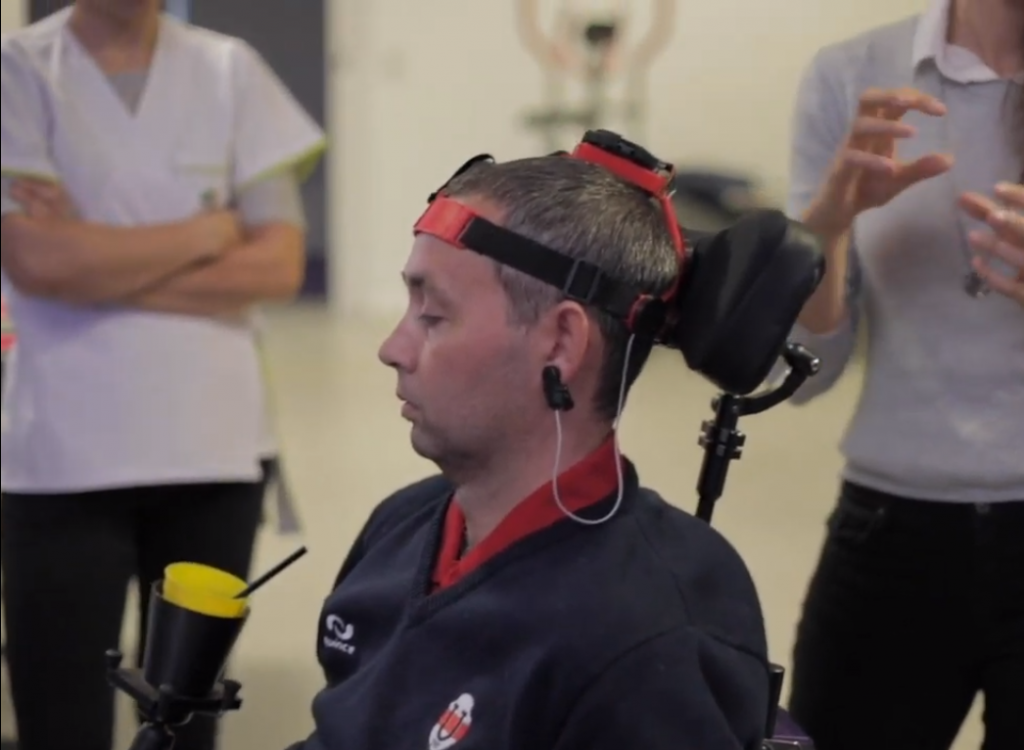
We evaluated the signal quality by computing the signal correlation, coherence, and Signal-to-Noise Ratio (SNR) of the SSVEP frequencies using the headband and Ag/ClAg electrodes simultaneously, to evaluate the difference between them. We obtained a mean correlation of 0.85 for opened-eyes state and 0.83 for closed-eyes state, and a mean coherence of 0.78 and 0.81 respectively. SNR for dry electrodes was 3.81 and 3.24 for wet electrodes.
We also evaluated the user’s comfort level while wearing the headband on 13 subjects. The comfort’s level was reported above 8 points in a 10-point scale (1 = very uncomfortable, 10 = Very comfortable) by 69.3 % of the participants, both during the headband’s placement and during a 30-minute test of continuous signal recording.
We are now working on the next design iteration to improve the headband and test it with more users with speech and motor impairment. Our project is supported by ExpoLive Grant, an Expo 2020 Dubai initiative.
We are very excited about sharing our work with the OpenBCI community, and we would like to thank the OpenBCI developers for the amazing work that they are doing, boosting up BCI developments all over the world and helping us to make our mission real, that is to return the voice to those who lost it.
In this link, you can download the design and print files of our headband design. Enjoy and share!
Cheers!
The OTTAA team
This files are trashed by owner.. I needed those for my ssvep project
Hi! I’m Hector CTO of OTTAA Project.
you can find the files in this repo!
https://github.com/OTTAA-Project/headband-bci
Please contribute to that repo! See you!