1. What are we doing?
We are validating coAR.BCI (coAdaptive Rehabilitative BCI) for the first time in a clinical setting, evaluating how the tool performs in individuals who have suffered a stroke. This is a collaborative project that presents a major challenge in transferring technology into clinical practice. This a follow-up of Dr. Peterson project “Low-cost BCI system for motor imagery”. It stands out as a collaborative research that aim at tackling the challenge of transferring technology out of the lab into clinical practice.
coAR.BCI is a low-cost, co-adaptive Brain-Computer Interface (BCI) designed by the Applied Computational Neuroengineering Laboratory (NiCaLab), IMAL, UNL-CONICET, specifically for upper-limb motor rehabilitation. It focuses on optimizing the user’s learning process to control the BCI. Participants use the interface by imagining the movement of grasping with their affected hand. This movement is then used to control a hand avatar in a video game, where the goal is to catch coins.
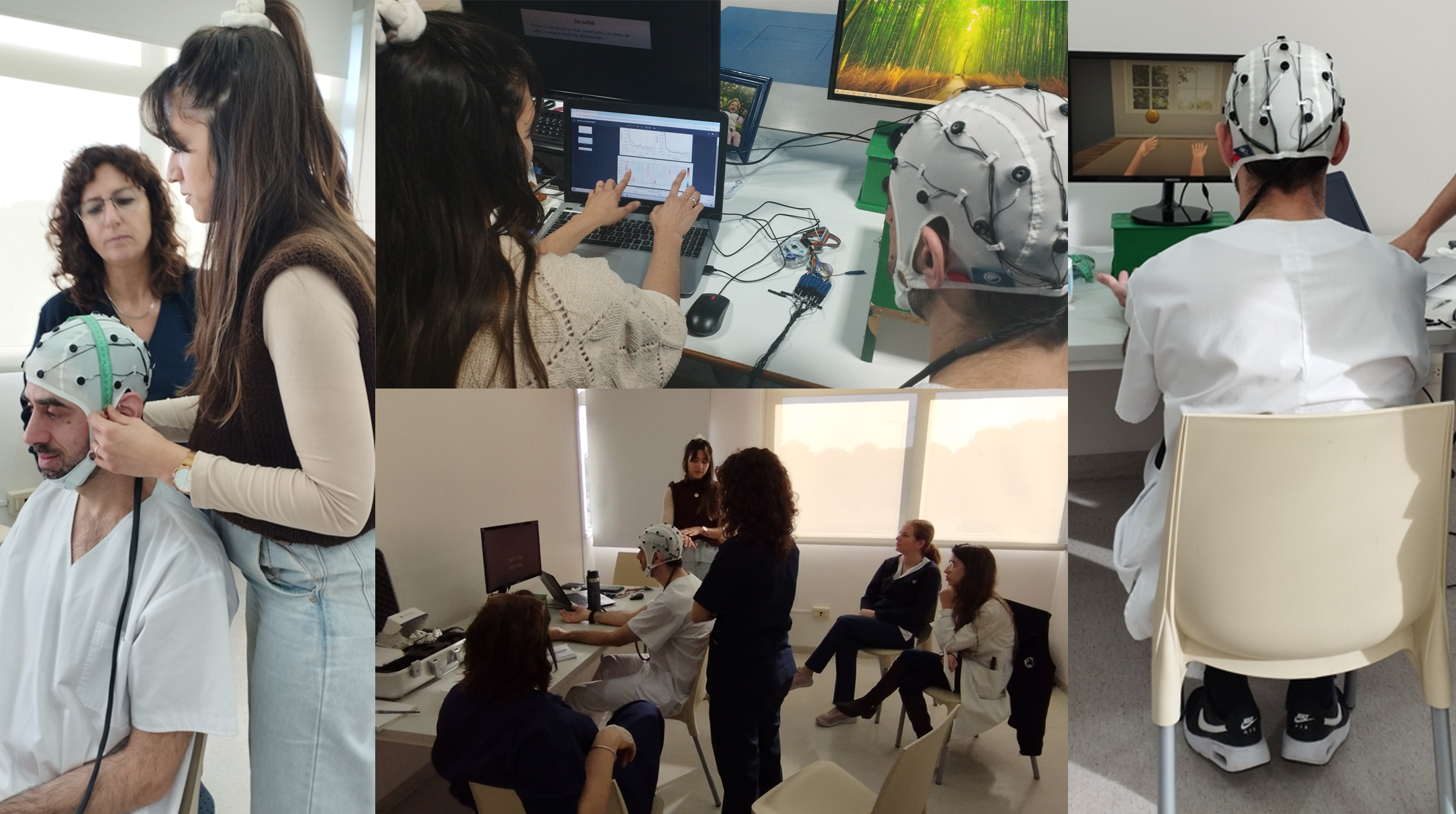
The distinctive feature of the system designed by NiCaLab lies in its proprietary SBA algorithm (supportive backward adaptation). This algorithm integrates learning from both the user and the machine, allowing EEG data to adapt across sessions. This is crucial because it reduces the need for retraining in every session, enabling faster familiarization with BCI.
Preliminary results in healthy participants suggest increasing user autonomy as they progress with the tool. Through this collaboration, we aim to implement a randomized clinical trial with 12 subacute post-ischemic stroke patients at Fleni, Argentina, a leading rehabilitation center in Argentina and Latin America, specialized in neurological disorders.
2. How is OpenBCI technology applied?
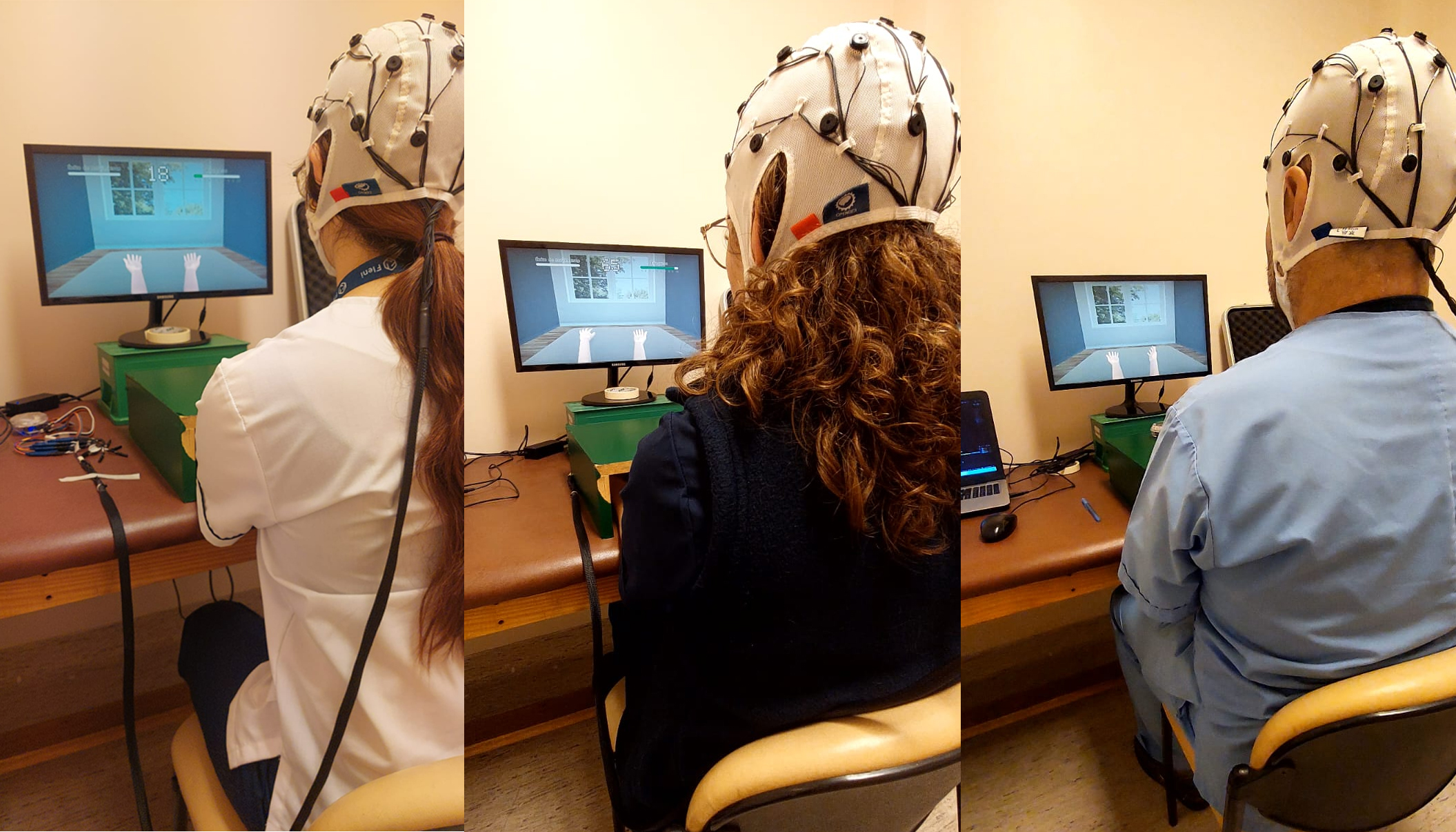
We are using OpenBCI technology to record brain and muscle signals in a real clinical environment:
We use the following devices:
- EEG: The Cyton + Daisy Board (16 channels) is used to record electroencephalography (EEG) from 15 positions in the sensorimotor area of both hemispheres.
- EMG: The Ganglion Board (4 channels) is used to record surface electromyography (EMG) from the wrist extensor muscles.
In previous experiments, the NiCaLab team developed custom software to simultaneously acquire data from both the Cyton+Daisy and Ganglion boards, allowing for synchronized signal recording from both EEG and EMG sources in real-time.
Our choice of OpenBCI underscores a commitment to open science and accessibility. By using this low-cost hardware in a rigorous clinical trial, we demonstrate that high-impact BCI research is feasible with more accessible resources, which is vital for research and clinical centers with limited budgets.
Additionally, the coAR.BCI software is based on the open-source platform OpenBeta (https://github.com/NiCALab-IMAL/OpenBeta), further contributing to the open-source community.
3. Why is this project important?
This project has both clinical and technological implications:
- Innovation in Stroke Rehabilitation: Stroke is a leading cause of disability. BCIs hold immense potential for motor recovery, and improving patients’ ability to control these interfaces opens new avenues for recovery and autonomy.
- Algorithmic Advancement (SBA): The SBA algorithm represents a significant step forward in person-machine co-adaptation, addressing a key challenge in BCI applicability: cross-session signal variability. Preliminary results in healthy participants already indicate a reduction in algorithmic assistance, suggesting increased user autonomy over sessions.
- Transparent Neurofeedback Assessment: The study’s central hypothesis is that transparent neurofeedback (providing clear information on mental activity quality) will enhance the sense of agency and accelerate patient familiarization with the BCI.
Clinical Validation of OpenBCI: Our project will generate valuable evidence and publications on the effectiveness of OpenBCI hardware in a stroke rehabilitation clinical setting, expanding its perception beyond pure engineering applications.
4. Who is involved in this project?
This project is a robust collaboration between leading research and rehabilitation institutions in Argentina:
NiCALab. Applied Computational Neuroengineering Laboratory (NiCALab), IMAL, UNL-CONICET in Santa Fe, Argentina. IMAL, CONICET-UNL
- Dr. Victoria Peterson Project lead – Principal Investigator.
- Catalina M. Galván PhD student
- Denise Nigro. Master student
- Solange Gualpa. Undergraduate student
- Rubén Spies. Co- Investigator
Fleni (www.fleni.org.ar) — a leading neurorehabilitation center in Argentina and Latin America.
- Marcos Crespo: Bioengineer. Head of Rehabilitation Engineering (Primary Contact at Fleni)
- Christian Gath. Physical Therapist. Clinical lead for the project
- Vanina Lado: Occupational Therapist
- Melania Ron: Occupational Therapist, Department Head
- María Elisa Rivas: Physical Therapist, Department Head
- Micaela Hernández: MD. Neurologist
NiCALab Resources and Previous Publications (Using OpenBCI):
The NiCALab team has previously validated and used OpenBCI hardware, and has shared datasets generated with this equipment:
- coAR.BCI Software:
- Repository: https://github.com/NiCALab-IMAL/OpenBeta
- Feasibility Study (2020): Feasibility study of a complete low-cost consumer-grade BCI system (using OpenBCI)
- Reference: Peterson, V., Galván, C., Hernández, H., & Spies, R. (2020). A feasibility study of a complete low-cost consumer-grade brain-computer interface system. Heliyon, 6(3).
- https://doi.org/10.1016/j.heliyon.2020.e03425
- Dataset (2022): Motor imagery vs. rest dataset generated with low-cost EEG hardware
- Reference: Peterson, V., Galván, C., Hernández, H., Saavedra, M. P., & Spies, R. (2022). A motor imagery vs. rest dataset with low-cost consumer grade EEG hardware. Data in Brief, 42, 108225.
- doi: 10.1016/j.dib.2022.108225
- Algorithmic Advancement (SBA): On optimal transport for motor imagery BCIs and co-adaptive systems
- Reference (2021): Peterson, V., Nieto, N., Wyser, D., Lambercy, O., Gassert, R., Milone, D. H., & Spies, R. D. (2021). Transfer learning based on optimal transport for motor imagery brain-computer interfaces…
- DOI: 10.1109/TBME.2021.3105912
- Reference (2025): Peterson, V., Spagnolo, V., Galván, M.C., Spies, R. D., & Milone, D. H. (2025). Towards subject-centered co-adaptive brain-computer interfaces based on backward optimal transport.
- DOI: 10.1088/1741-2552/addb7a
Primary Contact:
- Marcos Crespo
- Head of Rehabilitation Engineering, Fleni
- Email: [email protected]
- LinkedIn: linkedin.com/in/mkcrespo
Leave a Reply
You must be logged in to post a comment.