Greetings everyone,
We’re excited to announce that we are now providing the choice between an 8-bit Atmega328 core made by Atmel (with Arduino bootloader) and a 32-bit PIC core made by Microchip (see chipKIT for reference). This option is available to all backers that have selected a reward that includes an OpenBCI Board. We will send out a survey at the end of the campaign to make sure you receive the microcontroller that works best for your needs.

If you’re wondering which core you should go with, here’s a little info to start you off! We encourage all backers that are using or plan to use the Daisy-Chain Kit to select the 32-bit PIC32 core. It is a more powerful internal hardware design, capable of faster data rates at higher channel counts. The tradeoff is that the 8-bit option is better suited for novice programmers and people already familiar with the Arduino environment. The 8-bit option will be preprogrammed with the Arduino bootloader, making it instantly programmable with all Arduino code. The chipKIT development environment (used with the PIC32 core) is based on the Arduino IDE, but modified to support PIC32. It is compatible with many existing Arduino code examples, reference materials and other resources. I’m sure there will be plenty of questions about this option. We will do our best to field them quickly and update the FAQ and story to provide you with all of the information you need to make the right choice. Be sure to do your own research as well, to be certain you maximize your OpenBCI reward!
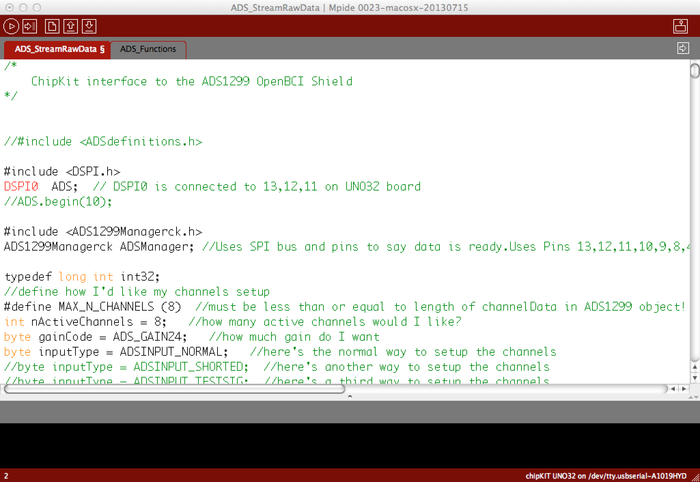
The chipKIT development environment based on Arduino’s IDE
Shifting gears, we just posted the video (seen below) of the Culturehub/Volumetric Society event from this past Monday. If you were unable to attend but wish you could have been there, go ahead and give it a watch! To start the event off, Conor gave a brief talk on the current state of BCI and their practicality in everyday life. The the talk transitioned into OpenBCI’s role in the industry and the effects that open-source will have on accelerating brain research and innovation. Afterwards, Joel dug into some of the nitty gritty details of the OpenBCI hardware and its noise levels compared to the claims of the ADS1299 datasheet. At the end of the chat, Joel and Conor fielded questions from the audience while demonstrating the OpenBCI Brainwave Visualizer in real-time, revealing Aisen’s beautiful brainwaves to the world!
All the best,
The OpenBCI Team