The thing we love most about OpenBCI is our amazingly diverse and inspiring community of hackers, neuroscientists, makers, and more! To celebrate you, we have decided to feature our favorite recent community project in each newsletter. If you are interested in being featured or know someone who has a cool OpenBCI project that they might want to share, please email us at [email protected]!
We’re excited to spread the word about teams using OpenBCI for academic research and that we think deserve an OpenBCI cool badge! We hope it inspires you to get your hands on some of our tech and do experiments of your own!
This month we’d like to highlight the work of Department of Biomedical Engineering students at the University of Houston.

Important Takeaways/Why It Works:
Testing of the OpenBCI EEG Headset to prove validity of the raw data, through observation of visually evoked potentials (VEP)
Robust acquisition, streaming, and analysis via both OpenViBE and MATLAB
Algorithmic Dual-Method Classification of neuro-electrical data into directional signals
people unable to communicate, either verbally or physically. One method for restoring
communication is a brain-computer interface (BCI), which uses electrical signals collected from
the brain to control some external device. Many current BCIs used for locked-in patients require
visual cues or invasive procedures to accurately predict communication or movement, and are
not long-term solutions. Last semester (Fall 2017), we decided to design a brain-computer interface using electroencephalography (EEG) with dry electrodes to control computer cursor movements, and we will attempt reduce the training time from a couple of weeks to a couple of hours.
The EEG headset was successfully ordered and assembled, data
was been collected and streamed into various software, and we decided to use OpenViBE
and MATLAB software in conjunction with each other. Additionally, at the suggestion of our
mentors, the headset was validated to prove that it can be used for meaningful EEG analysis
through observation of visually evoked potentials (VEPs).
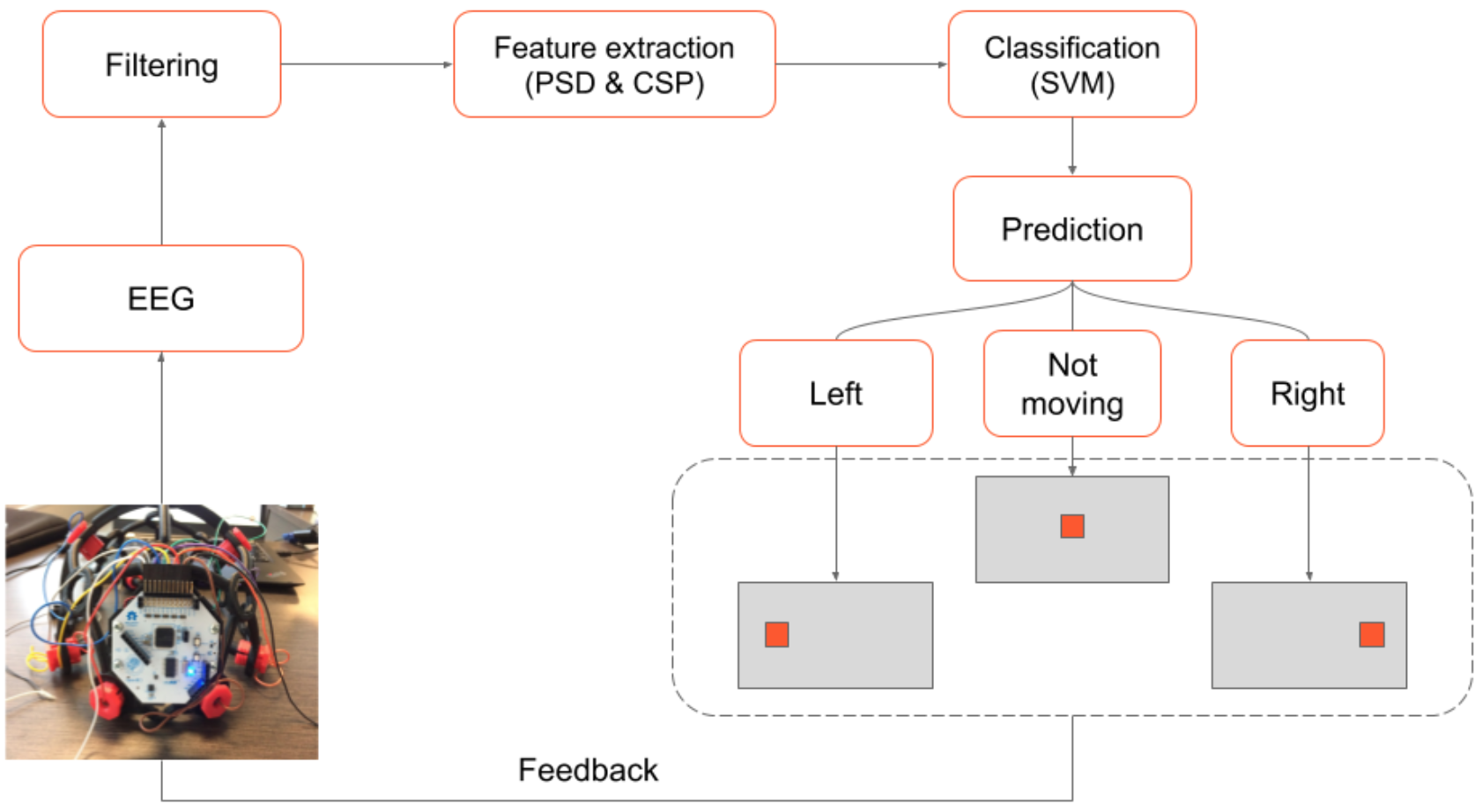
We started with an offline classification method that uses a simple binary classifier with
two classes: left and right. We then moved to making the classifier a three-class classifier, but the
accuracy of our classifier decreased drastically. After speaking with our advisors, we came to the
conclusion that we needed to create a two binary classifier structure to account for moving (left,
right) and not-moving.
We have an offline and online classification method of motor execution data (left
and right movement signals). Offline, we use a static set of data that is simultaneously fed into
two binary classifiers to predict left or right and moving or not-moving. Once we accomplished
the offline procedure, we began to create an online algorithm. The online algorithm is fairly
similar, only differing in how the classifiers work together. Unlike in the offline algorithm, the
second classifier is dependent on what the first classifier predicts. If the subject decides to move
left, the first classifier predicts whether there was movement. If the first classifier predicts
movement, then the second classifier predicts if the movement was left or right. Once the online
classifier was successful, we interfaced it with a cursor control GUI where the user controls the
cursor to move either right or left (or not move) and the cursor clicks on targets shown on the GUI.”
Why it gets the OpenBCI cool badge?:
It’s part of a rapid increase in undergraduate incorporation of Brain-Computer Interfaces in research. We see this as a first-hand indicator of growing exposure and awareness of BCI as the future of rehabilitation, therapy, and treatment!
Authors: Department of Biomedical Engineering students at the University of Houston Faheem Ershad, Ethan Hart, Zhihe (Harrison) Zhao, and Kaitlyn Robinson, with support from advisors Dr. Sridhar Madala, CEO of Indus Instruments (Webster, TX) and Dr. Joe Francis, Associate Professor in the Department of Biomedical Engineering at the University of Houston (Houston, TX). Mohammad Badri, Thinh Nguyen, and Tom Potter (graduate students at the time of writing)
Leave a Reply
You must be logged in to post a comment.