By Aryaman Bhatia and edited by Prakhar Sinha

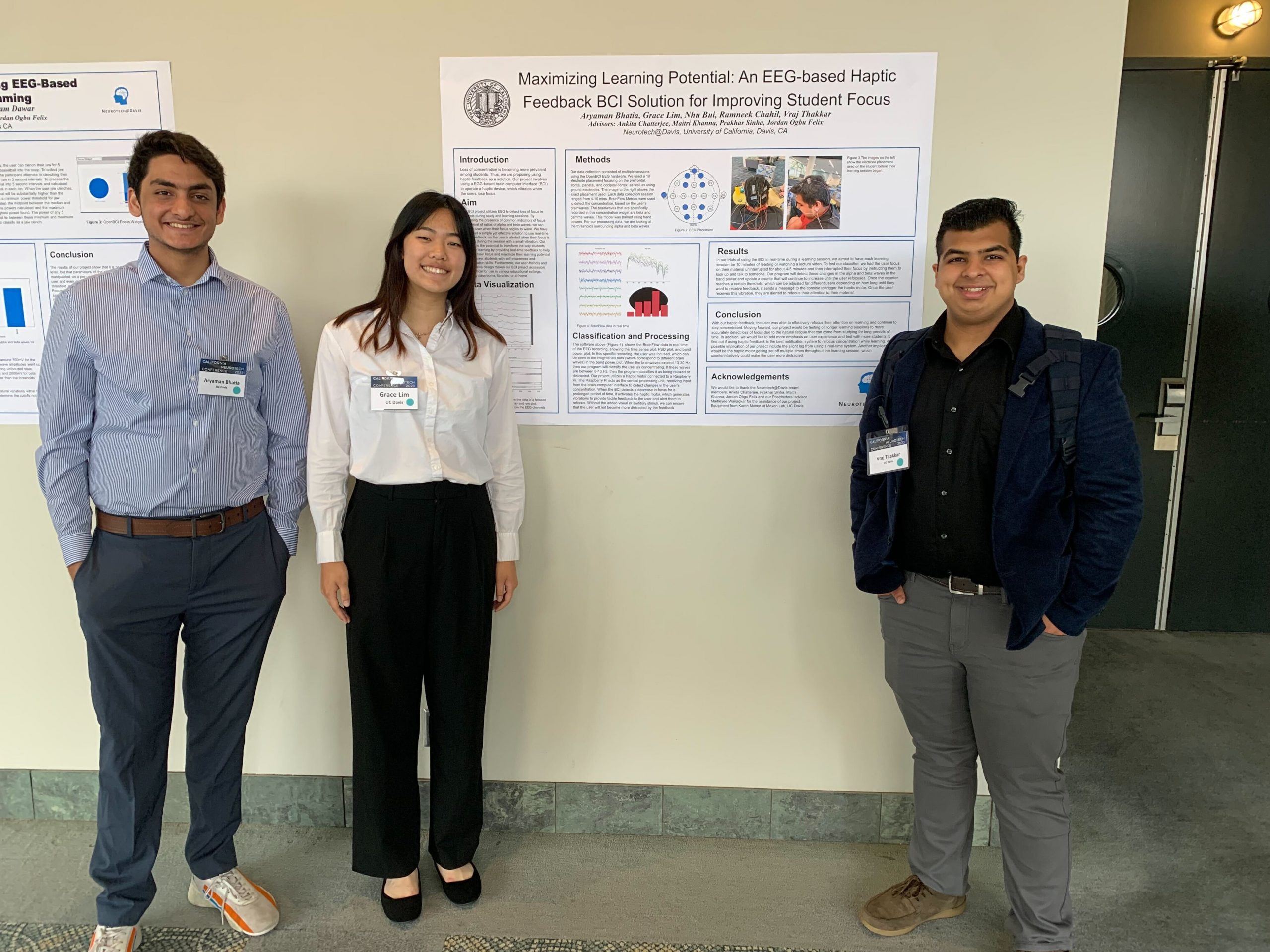
Loss of concentration is something that many college students struggle with. Whether that is due to burnout, late-night study sessions, or a general inability to focus, it’s something that everyone has experienced before. The team consisted of Aryaman Bhatia, Grace Lim, Nhu Bui, Ramneek Chahil, Vraj Thakkar, Maitri Khanna, Jordan Ogbu Felix, Prakhar Sinha and they decided our team name would be RegressionX. As they started the initial stages of brainstorming, this was one of the first ideas they came across. It sounded like an interesting problem to tackle. How would we go about helping students maintain their focus over long periods of time? Would it be possible for our BCI to detect someone is unfocused before they themselves were aware? These were all big questions that were on their mind but they were ready for a challenge.
In the initial stages of conceptualizing their BCI project, the team drew inspiration from our shared experiences as college students. Late-night study sessions were a shared experience, and they recognized the struggle to maintain focus amidst distractions. It was during one of these moments that the idea for a focus-based BCI began to take shape. They wanted to answer the question of how they could help people, particularly students, to stay focused while doing homework and maximize productivity.
As they slowly started coming up with a game plan over the coming weeks, they identified the key issue that would need to be targeted first. That being “How do we identify lapses in concentration?” They got to work. In their preliminary research, they employed the OpenBCI Cyton and a wet electrode system to study a control group. This group would engage in typical student-oriented tasks that required a high level of concentration, such as reading physical educational books, watching lecture videos, and viewing online educational content. They looked at what different brainwaves changed and fluctuated given the task at hand and whether someone was in a focused or unfocused state. They initially determined if a user was focused or not, as well as the level of their concentration, through the focus widget in the OpenBCI GUI. After they found that the focus widget agreed with user feedback regarding their own focus, they proceeded with the project.
In our real-time BCI trials during learning sessions, they aimed for 10-minute intervals of reading or watching lectures. To evaluate the classifier, they had users sustain uninterrupted focus on their content for roughly 4-5 minutes, followed by a brief interruption for social interaction. The program identifies shifts in alpha and beta wave band power, updating a counter that steadily rises until the user regains focus. Upon reaching a customizable threshold aligned with individual preferences for feedback timing, it sends a console message to activate the haptic motor. This vibration prompts users to redirect their attention back to their material.
The next problem to tackle was related to the user feedback portion of the project, What do we do after we determine the user is unfocused? The primary concern was to avoid introducing additional distractions for the student. They initially experimented with using desktop notifications to alert users when their focus waned. However, it was soon recognized that this choice was counterproductive, as it added to the distractions. After careful deliberation, it was opted for a more subtle approach—utilizing a small vibration from a haptic motor. This choice ensured that users received feedback without any visual stimuli, allowing them to seamlessly refocus on their task without the need to divert their attention to a new notification.
This is not to say that this project proceeded without its fair share of challenges. There were quite a few roadblocks along the way. The most notable ones were understanding how to make the real-time data streaming work with the OpenBCI and having to switch from using the Raspberry Pi to an Arduino. Real-time data streaming was a challenge that was mostly handled by Prakhar. He used the open-source biosensing and data streaming library called Brainflow. Additionally, late into the project, the group realized that using a Raspberry Pi was becoming more of a hindrance than an asset and decided to transition to using a more simple Arduino microcontroller. This was stressful as it was in the very late stages of the project but they were able to get it done on time.
In the end, with the incorporation of our haptic feedback system, users were able to effectively redirect their attention towards learning and maintain a higher level of concentration. In the still ongoing project, they aim to extend our testing to encompass longer learning sessions, allowing us to more accurately identify instances of diminished focus resulting from the natural fatigue associated with extended study periods. Furthermore, they plan to place greater emphasis on enhancing the overall user experience and plan to conduct experiments with a larger cohort of students to ascertain whether haptic feedback remains the optimal notification method for rekindling concentration during learning. One potential consequence of the project involves addressing the minor latency introduced by the real-time system. Another consideration pertains to the potential for the haptic motor to activate multiple times during a learning session, which, somewhat paradoxically, could lead to increased distraction for the user.
Although this endeavor may seem complete, RegressionX is looking forward. In the future, they expect efforts to be dedicated to further improving the devices due to the aforementioned limits. For example, a notification system could be developed into an app for a better user experience. Upon improvements, the device can provide better service for a wider range of users and purposes. For instance, upon improving the notification system, classrooms and students can use the BCI without causing disruption to other people. In conclusion, RegressionX foresees that the potential of the device will continue to increase as long as further improvements are made.
(The link to our YouTube project submission can be found here)
Leave a Reply
You must be logged in to post a comment.