Hi fellow brain-interfacers,
In addition to EEG circuit design, we’ve been super busy attacking the EEG headwear problem from an entirely new angle. Throughout the design process, our goal has been to find a solution that is truly customizable while still taking into account cost, comfort, and signal quality. The reason we think customizability is such a key part of the BCI design challenge is because of the novelty of field. There are still so many unknowns in other aspects of the overall BCI design challenge. Low-cost BCI research and development should not be limited by fixed electrode systems that require you to repeatedly sample data from the same regions of the scalp.

Spider Claw (working title…) – a 3D-printable EEG headset for OpenBCI
At first we considered an injection-molded solution with a semi-fixed form factor but quickly realized this would entail making a lot of assumptions to create a “one-size-fits-all” headset. Inevitably, that design would be too big or too small for some. In addition, because the major cost of injection molding is the design and creation the initial mold, the process would limit iterative design. As a result (and in the spirit of open source) we designed the first 3D-printable EEG headset, with a heavy emphasis on customizability.

4-view screenshot of the Spider Claw digital prototype in Autodesk Maya
Because we want OpenBCI to be beneficial for researchers as well as novice brain hackers, we made sure our design implemented the International 10-20 system – the internationally recognized method for placing electrodes on the human scalp in the context of EEG. We wanted the design to support electrode placement anywhere on the 10-20 diagram, but at the same time, not be bulky and uncomfortable as a result of extraneous components. Because of this, we designed a hierarchical system of snap-in pieces, allowing for a comfortable, personalized headset design.
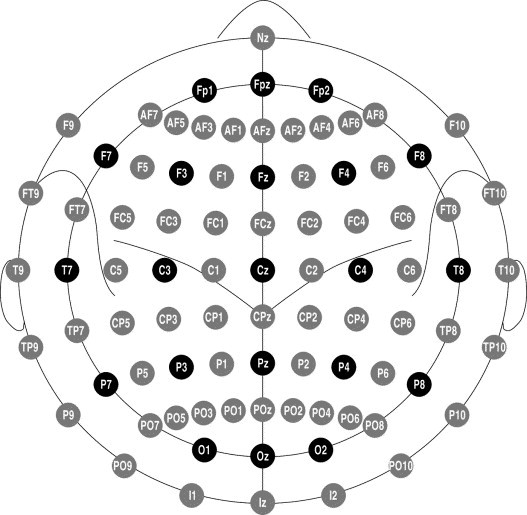
A top-down diagram of the International 10-20 System

A screenshot showing the “snap-in” functionality of the headset design
The body at the back of the 3D-printable headset design (positioned over the visual cortex) has a mount for the OpenBCI Board as well as a slot for a rechargeable lithium battery. The removable arms that extend from the body have nodes where a variety of different hands (1-electrode, 3-electrode, or 5-electrode) can be snapped into place. The option of choosing between 1 and 5 electrodes allows you to target general or granular regions of the scalp, while sticking to 10-20 standards.
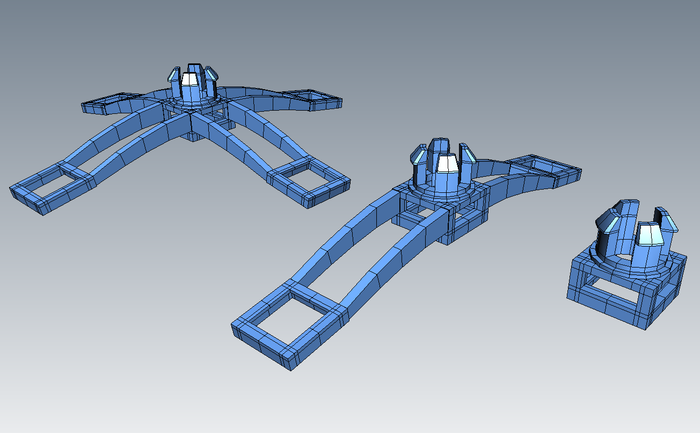
5-electrode, 3-electrode, and 1-electrode “snap-in” Spider Claw electrode mounts
To support the assembly and customization of the OpenBCI 3D-printable EEG Headset, we’re developing an online interface that enables you to drag and drop components while visualizing a 3D render of your headset. The interface will also have inputs for important head dimensions (inion-to-nasion distance over the top of the scalp and around the side of the scalp) to algorithmically generate an appropriate headset size. The interface will allow you to export 3D files (in common formats like .obj and .stl) that can be imported into 3D-modeling software like Maya, Inventor, or SolidWorks for further customization. Additionally, you will have the option to order a fully functional pre-printed version of an appropriately sized headset and desired components.

A digital mockup of the “OpenBCI 3D-Printable Headset Assembly Environment”
We will be publishing all OpenBCI 3D-Printable Headset files on our Github so that they can be improved by the masses. We hope that the open-source community takes our initial designs and perfects them over time, adapting them for numerous use-cases. 3D printing capabilities are improving rapidly each day and we think the field of BCI has a lot to gain from the potentials of this growing technology.
Cheers,
The OpenBCI Team